Showing posts with label Travel. Show all posts

Friday, June 10, 2011

Tomatina Festival 2009: Giant Tomato Fight

La Tomatina is a food fight festival held on the last Wednesday of August each year in the town of Buñol in the Valencia region of Spain. Tens of thousands of participants come from all over the world to fight in a brutal battle where more than one hundred metric tons of over-ripe tomatoes are thrown in the streets.

Approximately 50,000 tourists come to the tomato fight this year, multiplying by several times Buñol's normal population of slightly over 9,000. In preparation for the dirty mess that will ensue, shopkeepers use huge plastic covers on their storefronts in order to protect them.


read more "Tomatina Festival 2009: Giant Tomato Fight"

Tuesday, May 31, 2011

Top 10 Beaches in USA

Top 10 the best beaches in America, which was compiled by an expert Dr. Stephen P. Leatherman. “Dr. Beach” as it is called Stephen, is the head of the Laboratory for Coastal Research at the National University of Florida.

Siesta Beach, Sarasota, Florida

Beach Siesta, Sarasota County, Florida, famous for fine white sand and warm water, often ranks last in the annual ranking of the best beaches in America, in the same year it was the first time tops the list.

Coronado Beach in San Diego, California

Located about a mile from San Diego lies one of its best treasures. Coronado Beach is a great destination for the whole family. Your little ones can look for shells while the older kids will love body boarding in the gentle waves.

Kahanamoku Beach, Waikiki, Oahu, Hawaii

Almost everyone has heard of Waikiki Beach in Hawaii, which is surely one of the world's most beaches, with a location just steps from Honolulu's busy streets. Waikiki is actually a two-mile stretch with nine individually named beaches. Kahanamoku Beach is at the north end, near the Hilton Hawaiian Village Beach Resort.

Main Beach, East Hampton, NY

Main Beach has white sand, dunes, surf, lifeguards during summer, and spectacular fireworks on Labor Day weekend.

Cape Hatteras, North Carolina

Surfer love this beach on the coast of North Carolina.

National Park on the island of St. George, FL

In summer air temperature is 50-60 'Fahrenheit, it is cool enough to swim and sunbathe. Attracts fans for secluded relaxation. This place is also called "Forgotten Coast", because the majority of tourists still prefer the warmer coast and sent on vacation to the southern beaches of Florida.

Beachwalker Park, South Carolina

Located on Kiawah Island, Beachwalker Park offers 11 miles of unspoiled beach on one of the country's most beautiful barrier islands. Located between the Bohicket River and the ocean, the park features a wide boardwalk that weaves through live oaks, pines, palmettos, and yucca plants.

Coast Guard Beach, Massachusetts

The beach stretches for miles, has cliffs, dunes, good swimming in summer, body-surfing and boogie-boarding.

Gulf of Waimanalo, Oahu, Hawaii

Long white beach of the Gulf Waimanalo on displaying the Oahu, Hawaii, attracts thousands of tourists.

National Park on the Gulf of Florida

This beach will satisfy the demands of even the most demanding traveler: clean and clear water, gentle surf and white, fine sand.
read more "Top 10 Beaches in USA"

Thursday, April 14, 2011

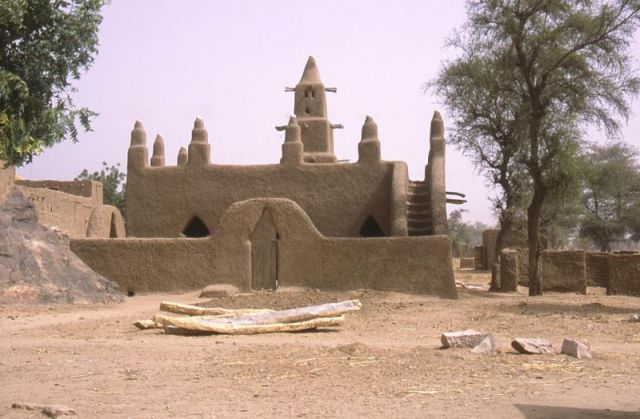
The Great Mosque of Djenné - The Largest Mud Brick Building in the World

The Great Mosque of Djenné is the largest mud brick building in the world. The mosque is located in the city of Djenné in Mali on the flood plain of the Bani River. It is one of the most famous landmarks in Africa. Along with the 'Old Towns of Djenné' it was dubbed a World Heritage Site by UNESCO in 1988.

The date of construction of the first mosque in Djenné is unknown but dates as early as 1200 and as late as 1330 have been suggested.

The walls of the Great Mosque are made of sun-baked mud bricks called 'ferey', a mud based mortar, and are coated with a mud plaster which gives the building its smooth, sculpted look. The walls are between 16 in and 24 in (0.4 to 0.6 m) thick. The thickness varies depending on the wall's height: taller sections were built thicker because the base has to be wide enough to support the weight. Bundles of deleb palm wood were included in the building to reduce cracking caused by frequent drastic changes in humidity and temperature and to serve as readymade scaffolding for annual repairs.


The walls insulate the building from heat during the day and by nightfall have absorbed enough heat to keep the mosque warm through the night. Gutters, made of ceramic pipes, extend from the roofline and direct water drainage from the roof away from the walls. Half of the mosque is covered by a roof and the other half is an open air prayer hall or courtyard. The roof of the mosque is supported by ninety wooden pillars that span the interior prayer hall. Vents in the roof are topped with removable ceramic caps, which when removed allow hot air to rise out of the building and so ventilate the interior.

The Great Mosque was constructed on a raised platform with a surface area of 5625 m² (62,500 ft²), which has so far protected the mosque from even the most severe floods. (Wikipedia).


Source: clarepawley
read more "The Great Mosque of Djenné - The Largest Mud Brick Building in the World"